
Say you were rear-ended on I-35 and you're hurt. Somewhere along the way you saw a headline verdict, a wreck that settled for a number big enough to make the news, and now you're wondering whether your case carries that same weight. It doesn't, and that has nothing to do with luck. What a case settles for comes from the damages in that case, not from a stranger's verdict on the news. There is no fixed price for a category of crash.
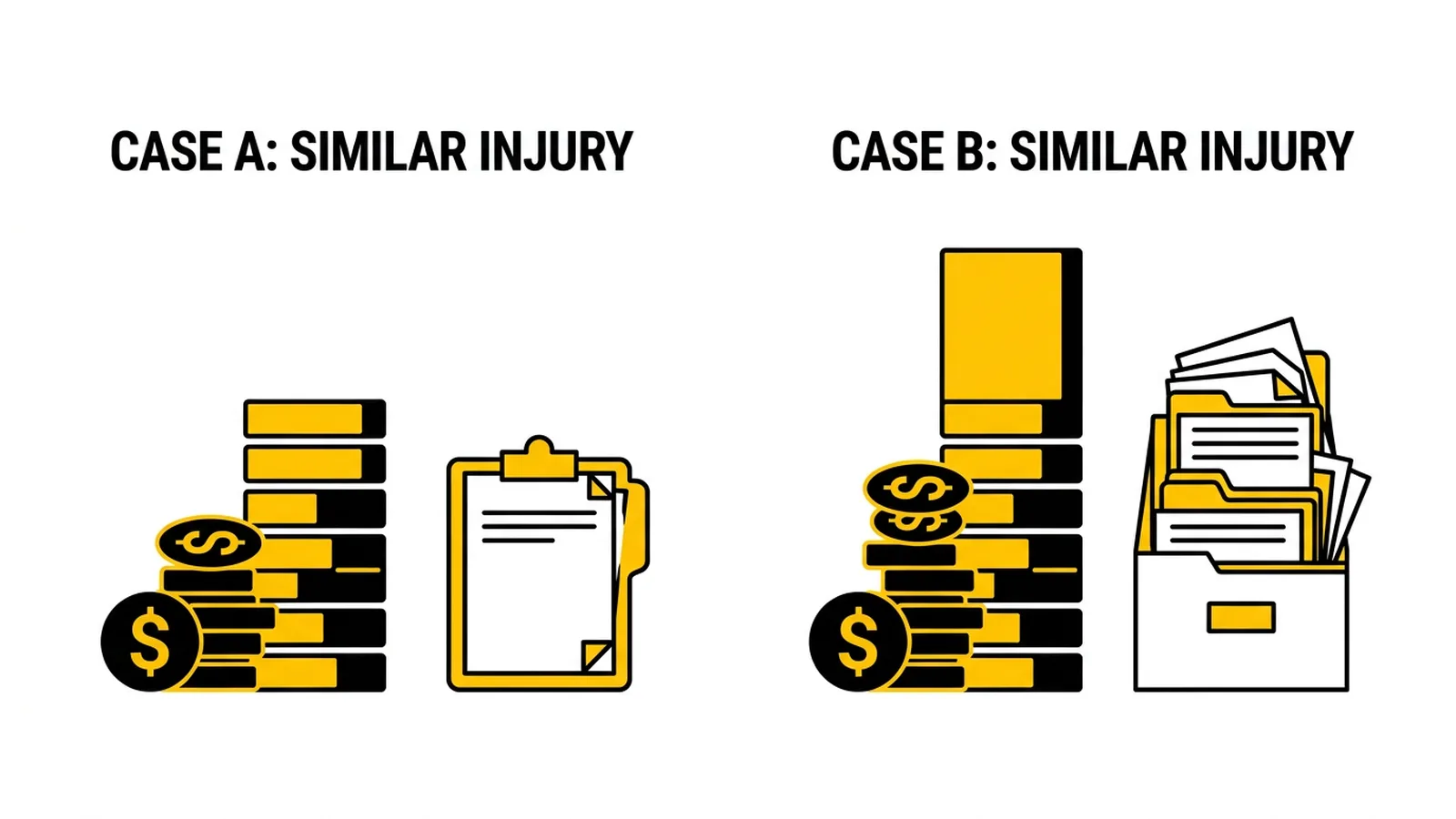
When people ask me what the average Fort Worth settlement looks like, I explain why the question doesn't work. They're called personal injuries for a reason. Your injuries, your diagnosis codes, your share of the fault and the insurance behind the other driver belong to your case and nobody else's. A lot of times two people are in similar wrecks, on similar roads, at similar speeds, and walk away with settlements that look nothing alike.
The ingredients, not the headline
So think of a settlement as something that gets built, not looked up. A lot of things go into it. Your specific injuries and the diagnosis codes attached to them. Whether you carried any portion of the fault. How clear the circumstances of the crash are. And the insurance coverage available to pay the claim, which sets a ceiling that no stack of records can raise.
That last ingredient is the one most people underestimate. Texas has an at-fault insurance system. Basically, that means the driver who caused the wreck pays, or more precisely, that driver's insurance company does. And so their policy sets the ceiling on what your claim can collect from them, whether they carry low coverage or high. A single visit to John Peter Smith after a crash can run past a state-minimum policy on its own. Chapter 9 covers what that ceiling looks like in dollars, and what you can do about it before a wreck ever happens.
Why online averages mislead
Google "average car accident settlement" and a number comes back. Put your facts into an AI tool and it hands you another one. Both are misleading, because no two crashes settle for the same amount, even when the accidents look alike. Those averages get pulled from cases with different injuries, different fault pictures and different insurance behind them, then flattened into one figure that describes none of them. A fender bender with no injury and a pileup that ends in surgery get folded into the same number.
A general tool has no access to your actual medical records. It has no way to know how a specific Fort Worth adjuster has historically valued a comparable injury. It has no way to know what coverage is sitting behind the other driver's policy. The number it hands you is a guess dressed up as an answer.
What drives the number
Strip away the averages and the marketing, and four things are left. Your injuries, and how well the records prove them. Who was at fault, and by how much. How clear the facts of the crash are. And the coverage available to pay. Every chapter that follows takes up one of those four. No good attorney will give you a specific number before those four are known, and I won't either.
Why liability clarity matters as much as the injury itself
How clear the fault is counts as its own ingredient, separate from how badly you were hurt. A rear-end collision or a driver who blew through a red light leaves an adjuster very little room to argue. I've been rear-ended on I-35 in Fort Worth myself, so I know that kind of case from both sides of the desk. When fault is contested, part of the fight shifts away from damages and toward proving who caused the wreck in the first place. That slows everything down. It adds another layer of proof on top of the medical records you already need. I walk clients through this on the first call. For a broader look at how your claim gets built from there, see what a car accident lawyer does for a claim like this on my firm's site.
Most of the fight is over damages, not who caused it
About 90 percent of the cases that come through our office are clear liability. A rear-end. A red light. A crash report that puts the fault on one side from the start. The fear most people lead with on that first call is whether the insurer will even believe their version of what happened. In practice, that's rarely the fight. What we're fighting about is damages, economic and non-economic, and that fight runs on proof.
Clear fault sets a floor for us. It takes away the adjuster's favorite move, which is putting a little fault on you to discount the number. But it doesn't finish the job. Even when the other driver plainly caused the wreck, we still have to prove your injuries through medical records, imaging and specialist opinions. An adjuster knows that clear liability with thin records is still a claim worth arguing down. So on most claims the negotiation runs through the same four ingredients: your injuries, the records behind them, the coverage available and the evidence tying it all back to the crash.
These settlement values are like cooking. Every recipe has different ingredients, right? And so, settlement values are typically driven by damages, not by a TV verdict. It's not a fixed number.
Common Questions
- What is the average car accident settlement in Fort Worth, Texas?
- There isn't one that applies to your claim, and I tell people that directly when they ask. Settlement value is driven by your specific injuries, how clear the fault is and the insurance coverage available in your case, not by a number pulled from unrelated claims. A soft-tissue neck strain and an injury that ends in surgery get folded into the same national averages you find online, which makes those figures close to useless for predicting what your case is worth.
- Why do online calculators and AI tools give unreliable settlement estimates?
- Because no two crashes settle for the same amount, and a calculator has no way to know what makes yours different. As I tell clients: "a lot of these averages that you see out there, you might Google them on the internet or put it into AI, they're very misleading, because no two crashes settle for the same amount." The estimate is a guess built on unrelated cases, not an evaluation of the claim in front of you.
- Does Texas use a no-fault or at-fault insurance system?
- Texas is an at-fault state. The driver who caused the crash pays for the damages, through that driver's own insurance company. That's different from a no-fault state like Florida, where personal injury protection benefits are mandatory and your own policy pays first, whoever caused the wreck. Because Texas is at-fault, the coverage the other driver was carrying becomes one of the central facts of your claim.
- Does it matter who was at fault if the other driver already admitted it?
- Yes. Clear liability removes one whole layer of the fight, but an admission alone doesn't finish the job. It's not enough to say you were hurt. We still have to prove the extent of the injury and its value through medical records, imaging and specialist opinions. Clear fault just means the negotiation can focus on damages instead of also litigating who caused the crash.
- Does clear liability mean my case will settle quickly, or for more money?
- Not by itself. Clear liability takes away the insurance company's argument over who caused the crash, but in most cases liability was never the real fight; the value of the damages is. A case with clear fault and thin medical records can take just as long to resolve, and settle for just as little, as a case where fault was contested. What moves the number is the same either way: how well your injury is documented.
Chapter Reflection
A settlement is a built number, not a looked-up one. That's the idea this whole book rests on. Once the four real ingredients replace the myth of an average, the process stops feeling random and starts looking like work you can do something about. The next chapter starts with the first of those ingredients: the losses a claim can put a dollar figure on. For the full talk this chapter is drawn from, listen to the original episode on my podcast.