
Say you were hurt badly enough to miss three weeks of work, and now your supervisor wants a date you'll be back. You don't have one to give. The hospital bills are stacking up somewhere in the background, but the loss that lands first is the paycheck that stopped coming. For a lot of the people who call my office, that's the part keeping them up at night, well ahead of any medical statement.
Work loss is one of the hard, provable numbers in a claim. It sits inside your economic damages, right next to the medical bills from Chapter 2. But it isn't one number. It splits into two, and each one gets proven a different way. A lot of claims capture the first and leave the second sitting on the table. The second one is usually the larger of the two.
Two buckets, not one
So when I walk somebody through work loss on a first call, I split it into two buckets.
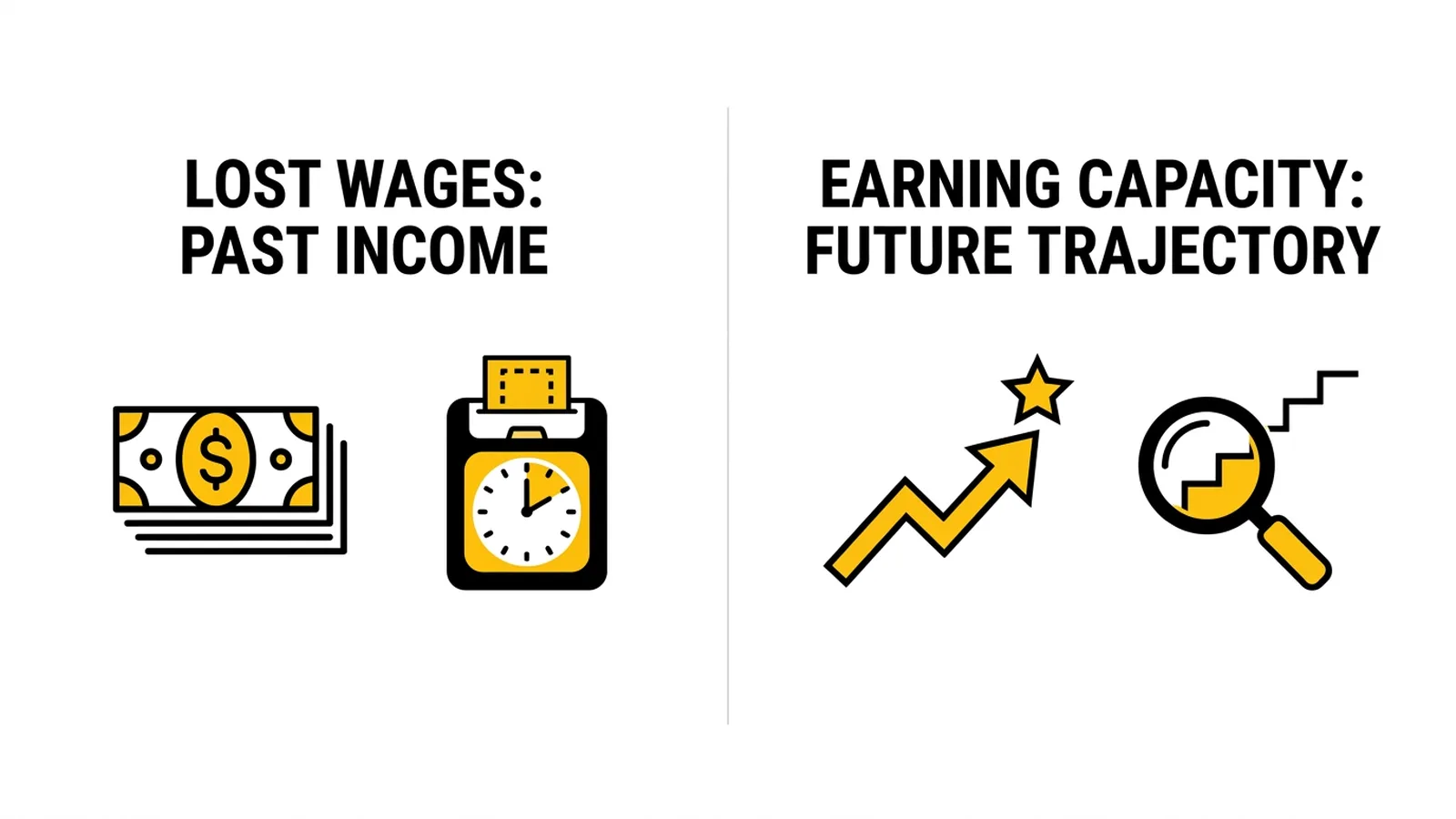
The first bucket is lost wages. That's time you missed from work because of the injury. Days, weeks, sometimes months, priced at what you were earning before the crash.
The second bucket is lost earning capacity, and it asks a different question. Can you do the job the same way you did it before? Are you going to get paid less because you're no longer able to do that same job? Basically, it measures your reduced ability to earn going forward, after the time-off question has been settled.
Both are drivers of economic damages. Both belong in the damages figure. But one of them is a receipt and the other is a forecast, and a forecast takes more work to prove.
Why wage-loss claims draw extra scrutiny
An adjuster looks harder at lost income than at a hospital bill. A fracture shows up on an X-ray. A reduced ability to earn doesn't show up anywhere on its own, so we have to build it for them.
An adjuster wants to see a chain. A documented injury, tied to documented treatment, tied to a documented inability to do specific parts of your job. There has to be a causal connection between the injury in your medical records and either the time you missed or the earning power you lost. It isn't enough to say it. If you stubbed your toe, that doesn't explain why you couldn't sit at your desk, and it won't make sense to an adjuster either. And so a wage claim that skips that connection gets picked apart, while the same claim with the chain intact usually doesn't.
This is the bread and butter here. This is where most attorneys will provide you value. And there's really two buckets, okay? So when you're talking about lost wages, it's lost wages, which is time that you've missed from work. And then there's also lost earning capacity.
Proving both categories
Lost wages get proven with paper you mostly already have. A lot of times we'll provide tax returns. Pay stubs showing what you were making. A letter from your employer documenting your pay rate and the exact time you missed. Then all of it has to tie back to the medical records that explain why you missed it.
Lost earning capacity takes a different kind of proof. We have to connect the injury in your records to a real, ongoing reduction in what you're able to do and what you're able to earn. That link isn't optional. If a wrist injury keeps you off a job site, the medical record has to say so. An assertion on its own carries very little weight with a Texas adjuster.
Why lost earning capacity can outweigh lost wages
A reduced ability to earn can dwarf the missed paychecks. That's the part most people don't see coming.
Think about an accountant making $100,000 a year. She's in a wreck, she has memory issues afterward, and she can't hold her focus the way the job requires. She isn't unemployed. She moves into a different kind of role, and in that role she doesn't earn as much. None of that loss shows up on a pay stub from the month of the crash. It shows up over the next twenty years.
We had a firefighter come through our Fort Worth office recently, thirty years old, seriously hurt in a motorcycle accident. He will never be able to work in that same capacity again. So the questions become where can he work now, and what kind of job could he actually do in his physical condition. Answering that isn't guesswork, and it isn't something you put in a demand letter on your own say-so. It takes expert testimony.
In a serious case, this is often the single largest component of the damages. In brain injury claims especially, the lost earning capacity number frequently ends up bigger than every medical bill in the file combined.
Why a career-long reduction compounds
The reason this bucket grows so large isn't complicated math. It's time.
Missed wages stop when you go back to work. Weeks, maybe months, and then that number closes. A real reduction in what you're able to earn runs as long as your working life runs. Get hurt in your thirties or forties and that's decades of it. Even a modest drop in what you make each year, carried across all the years you had left to work, adds up to a number that has nothing to do with how long you were out.
And so when the experts build this figure, they project the whole loss across your expected working life, not across your time off. We're not asking what the injury cost you during recovery. We're asking what it costs you every year after that.
Inside a vocational expert's analysis
When earning capacity is genuinely contested, we bring in vocational and economic experts. A vocational expert studies what work a person can still do after an injury, and an economist puts a number on what that change costs over a career. Between them they turn an injury into a dollar figure an adjuster or a jury can actually hold.
The vocational side takes the physical restrictions your treating physician wrote down and holds them up against what your old job demanded of you. Then the question is what work, and what pay, is still realistically open to you with those restrictions in place. A functional capacity evaluation, a formalized physical test a physician or specialist orders to measure exactly what you can and can't do, often becomes the bridge between your medical record and your wage-loss claim. It translates a diagnosis into concrete physical limits: how much weight you can lift, how long you can stand or sit.
It's the same link everything else in your claim runs on, just built out further. A documented medical limitation, tied to a specific, provable economic consequence. Don't just assert that the injury changed what you can earn, and don't leave an adjuster or a jury to close that gap on their own. They won't close it in your favor.
Proving loss when there's no employer to ask
If you're self-employed, you face a harder version of the same proof problem. There's no employer letter confirming a pay rate or documenting missed time. So your case has to be built instead from tax returns, business bank records, invoices, and sometimes a bookkeeper's or accountant's reconstruction of what your business would have earned if you hadn't been hurt. That's a more involved process than pulling a few pay stubs. But the underlying requirement is identical. The loss has to be shown with real financial records, not estimated from memory. The filings you already keep for tax purposes often end up doing double duty here. That's one more reason consistent, accurate bookkeeping before a crash ever happens quietly protects a claim you never expected to need. If you own a business and keep clean, current books, you rarely notice how much easier that habit makes proving a loss. You notice on the day it matters. By then it is too late to go back and fix a period that has already passed.
Common Questions
- What is the difference between lost wages and lost earning capacity?
- Lost wages are the actual pay you missed while you were out of work, documented through pay stubs and employer records. Lost earning capacity is the forward-looking bucket. It asks whether you can do the job the same way, and whether you'll be paid less because you can't. That one has to be tied to medical records showing the injury reduced what you're able to do.
- How do I prove lost wages after a car accident in Texas?
- A lot of times we prove it with tax returns, pay stubs showing what you were making, and a letter from your employer documenting your pay and the time you missed. Then that paperwork has to tie back to the medical records. There has to be a causal connection between the documented injury and the work you couldn't do. Without that connection, the pay stubs sit there proving nothing.
- Can lost earning capacity be worth more than lost wages?
- Yes. The reduced ability to earn going forward can dwarf the missed paychecks, and in a serious injury it usually does. Missed wages stop when you go back to work. A permanent reduction in what you're able to earn follows you for the rest of your working life. In brain injury cases especially, it often turns out to be the largest single component of the damages.
- Can I claim lost earning capacity if I'm self-employed?
- Lost income claims for self-employed individuals are proven the same way, through records. They often rely more heavily on tax returns, business records, and sometimes an accountant's or vocational expert's analysis, since there's no employer to issue the standard records.
- Do I need a vocational expert for every lost earning capacity claim?
- No. Straightforward cases, where an injury clearly prevents a return to a physically demanding job and the wage difference is easy to document through pay records, often don't need one. A vocational expert matters more when the connection between your injury and your earning loss is less obvious, or when the dollar amount at stake justifies the added cost of that analysis.
- What if I was between jobs or worked seasonally when the accident happened?
- Lost wages are still provable in that situation. They're just documented differently: through the prior year's tax returns, an offer letter for work you had to decline, or a documented pattern of seasonal earnings from previous years. Not having a single steady paycheck just makes the proof more detailed, not impossible.
- Can lost earning capacity apply if I'm able to keep the same job, just with more trouble?
- Yes, if the injury measurably reduces your overtime availability, your promotion potential, or your ability to sustain the same pace or hours long term, even while you're technically staying in the same role. The proof still has to tie those specific, documented limitations back to the medical record. Not just a general sense that work is harder now.
Chapter Reflection
Work loss is the part of a claim people feel most personally, and it's the part most often left half-proven. The paycheck you missed is easy to show. The harder number is what the injury costs you every year after that, and it's usually the bigger one. So get it documented, get the right experts on it, and make the adjuster account for both buckets instead of one. Then there's the other side of the ledger, which is where the next chapter goes: the two things in Texas law that can shrink your recovery no matter how well you proved it.