
You can hand an adjuster the bill for the injection in your neck. You cannot hand them the third night in a row you slept four hours, or the morning you could not lift your daughter into her car seat. Both are losses from the same crash. Only one of them arrives with a number already printed on it.
That is the whole problem with this category. Pain does not come with an invoice, and the losses in this chapter are the ones an insurance company cannot itemize. They are also where most of the real friction in a negotiation happens, because two sides who agree on every bill can still be tens of thousands of dollars apart on what the rest of it was worth.
Damages without a receipt
This category has a name, non-economic damages, and one short definition: the losses that leave no receipt behind them. In a serious case it reaches your mental anguish and any disfigurement. Where an injury changes what you can be for the people at home, a loss of consortium claim covers what you can no longer provide as a husband, a wife or a parent.
Those are real losses. They just resist the kind of objective proof a medical bill hands over on its own. An adjuster looks at a $12,000 injection and understands exactly what that number represents. Pain and suffering has no equivalent line item, and it means something different to every person who lives through it. So this piece of your claim does not get tallied up. It gets argued over.
One thing worth knowing before we get into how it gets argued: Texas does not cap non-economic damages in most personal injury cases. Medical malpractice is its own world with its own rules, and exemplary damages, the punitive kind reserved for fraud, malice, or gross negligence, carry a statutory cap of their own. But in an ordinary car accident case, nothing in the law puts a ceiling on what your pain and suffering is worth. What limits your number is what you can prove, and the coverage available to pay it.
Non-economic damages cover things like pain, like suffering, loss of enjoyment of life. And so a lot of times they can be hard for a jury or an insurance adjuster to understand, because pain is subjective. There's not always objective criteria like a medical bill.
How it gets proven anyway
Since there is no invoice for pain, the proof comes from somewhere else. Testimony, treatment history, and a documented picture of how everyday life changed from the day before the crash to the day after it. We talk about your baseline, meaning what you could do and how you felt before any of this happened, because the argument is built on the distance between that and where you are now.
In a catastrophic case the same argument sometimes gets made on video. A day in the life video follows you through an ordinary morning: getting dressed, getting up the stairs, the help you need with things you used to do without thinking. If a picture is worth a thousand words, a day in the life video is worth a million, because it turns an abstract legal term into something an adjuster or a juror can see. It does not make your loss bigger. It makes it visible.
And so this is also where the negotiating gets hardest. An adjuster's formulas are built to produce a defensible low number, and your side of the argument is the side that does not reduce cleanly to a spreadsheet.
The before-and-after comparison, and what holds it up
When I say the argument is built through testimony and treatment history, I mean something specific. It is a comparison. What did your daily life look like before the crash, and what does it look like now?
The same medical records that established causation and severity document that comparison at every step. A treating physician's note on limited range of motion. A specialist's restriction on lifting or sitting. A prescription history showing you still need something to sleep eight months later. Those become the concrete texture behind a claim that would otherwise be one person saying they hurt.
Testimony on its own, with no medical corroboration behind it, is exactly the kind of subjective account an adjuster is trained to discount. Testimony backed by a treatment history that matches it is a different argument entirely. That is also why the timing of your first visit to a doctor matters as much here as it does for causation in Chapter 5. A before-and-after comparison is only as good as the baseline it starts from, and a baseline recorded weeks later, after the worst of the pain has already faded, is a weaker starting point than one recorded in the first days.
The multiplier method
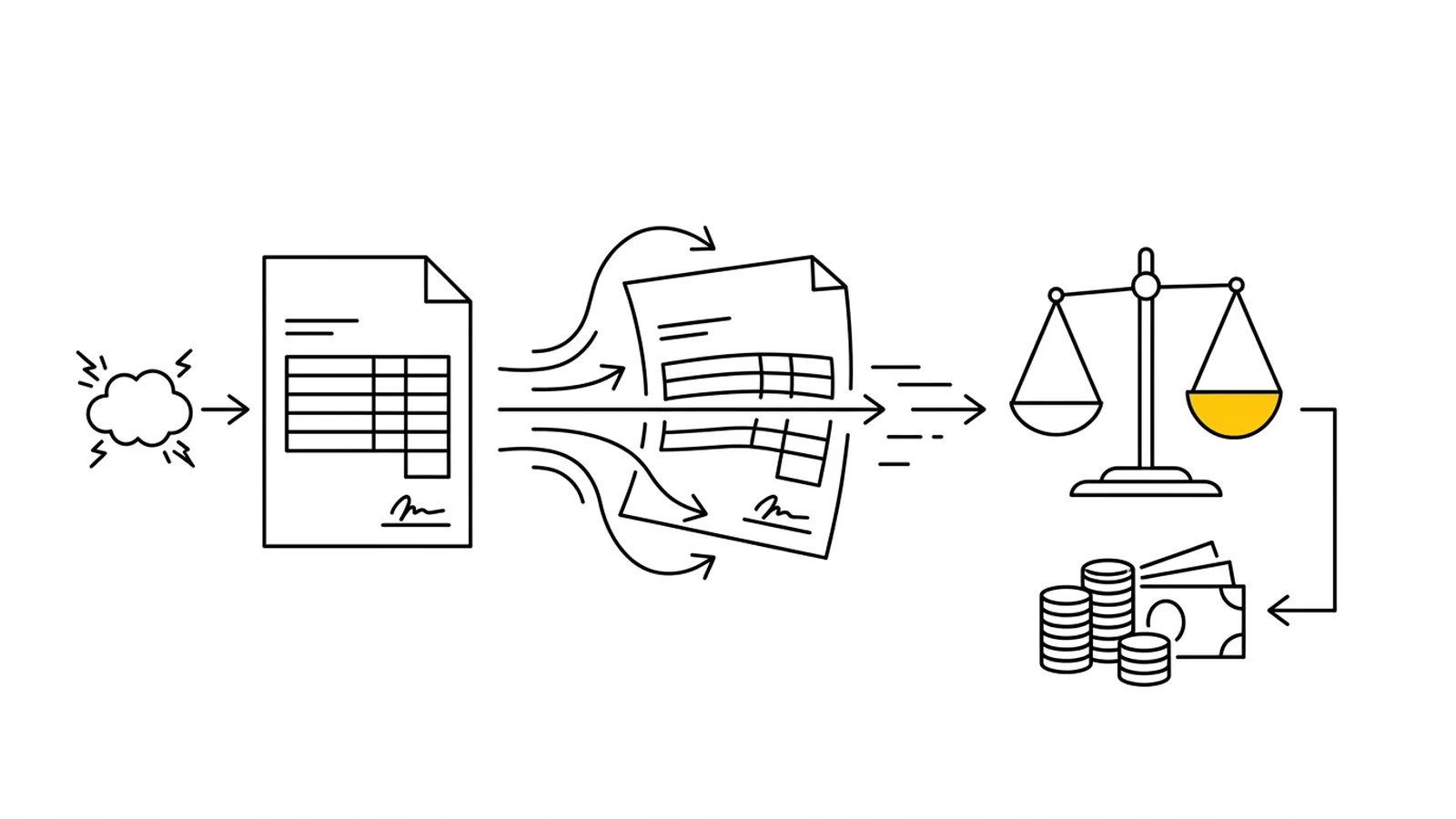
The tool adjusters lean on to turn an unquantifiable loss into a number is called the multiplier method. Basically, they take your economic damages, mostly the medical bills we have provided, apply a multiplier to that figure, and tie the multiplier to the severity of the injury. A minor soft-tissue injury draws a low one. A severe, well-documented, lasting injury pushes it up.
Some carriers run a daily rate instead, pricing out each day you have lived with the injury. Some run the whole file through software rather than a person. There is a well-known program called Colossus, where the adjuster feeds in the information and the program spits out a number. The math is not identical from carrier to carrier, but the shape of it is consistent: the input is your economic damages, and the lever is how well your injury's severity is documented.
That mechanical link matters more than it first appears. The first multiplier you are shown is set low on purpose, because it is a negotiation and they can always come up. A lowball multiplier is negotiable a lot of times, once the medical records support that the damage is more serious, or more permanent, than the opening number assumed. Better records move it. A louder argument does not.
Why the formula isn't public
No carrier publishes the multipliers it uses or the logic inside the software, and that opacity is part of the negotiating dynamic. You cannot look up what a herniated disc ought to multiply to, and neither can I. The number has to be argued for, case by case, out of the strength of the records.
Part of what gets argued is what a Tarrant County jury would likely do with the same records, because this is a moderate, conservative-leaning jurisdiction and both sides know it. So two claims with similar injuries can resolve at different multiplied values, and nothing improper has happened. Your injury is one input. What got documented, who documented it, and who is negotiating for you are the others.
Reputation lowers the friction before the negotiation starts
Some of the friction in pricing pain has nothing to do with your injury. It comes from what the adjuster expects to happen if they open low, and that expectation is set before your file ever reaches their desk.
An insurance company that has seen this firm decline an inadequate offer, and follow through when a case needed to be filed, prices your claim with that history already in it. Other than a policy limits tender, we have never taken a first offer. That is a track record, not a posture, and a credible trial threat backed by a record of actually trying cases moves a number in a way no amount of argument does. Adjusters have opened calls with me by saying, in effect, that they already know who they are dealing with. A slower negotiation that ends in the same place costs them money too.
So part of what moves a low opening multiplier is not volume. It is a demonstrated willingness to keep going until the number matches what the records support, case after case.
Common Questions
- What are non-economic damages in a personal injury claim?
- Non-economic damages are the losses that arrive with no receipt: pain, suffering, loss of enjoyment of life, and in serious cases mental anguish and disfigurement. They get proven through your testimony, your treatment history, and a documented comparison of your life before the crash against your life after it. Texas does not cap them in most personal injury cases, so what limits them is proof.
- How do insurance adjusters use the multiplier method to value pain and suffering?
- Adjusters take your economic damages, mainly the medical bills, and multiply that number by a factor tied to how severe your injury is. As I tell clients: "they look at the economic damages, right? The medical bills that we've provided, and they use a multiplier to factor, and they tie that to the severity of the injury." The multiplier is negotiable, and it moves up when the medical records make your injury's severity credible.
- Why does an insurance company's first multiplier tend to be low?
- Because it is a negotiation, and they can always come up. A low opening is easier to defend internally than a generous one, and a lot of people accept it. That number becomes negotiable once the records support an injury that is more serious, or more lasting, than the opening figure assumed. So thorough documentation, not a stronger opinion, is what moves it.
- Can pain and suffering be worth more than the medical bills themselves?
- Yes. The multiplier ties your non-economic damages to the severity and permanence of the injury, and Texas does not cap those damages in an ordinary car accident case. A well-documented severe injury can produce a pain and suffering figure well above the bills underneath it. That is why documenting severity carefully matters long after the medical bills have been paid.
- Does it matter which attorney negotiates my pain and suffering claim?
- It can. An adjuster's opening multiplier reflects what they expect to happen if it gets rejected. A firm with a record of declining inadequate offers and filing suit when a case calls for it changes that calculation before you are ever quoted a number. The injury is the same either way. What differs is how much of its value gets argued out of them.
- What kind of evidence makes a pain and suffering claim more credible to an insurance adjuster?
- Documented limitations carry far more weight than a description of pain. A physical therapist's note on what you still cannot do six months out. A specialist's lifting restriction. A prescription history for ongoing pain management. In a catastrophic case, a day in the life video. Each one ties something subjective to something objective and dated, which is exactly what a multiplier rewards.
Chapter Reflection
Pain has no invoice, so the whole category gets decided by how well the rest of your life was documented while you were living through it. That is the thread running from here to the end of the book. Nearly every dollar figure ahead traces back to how thoroughly an injury's severity and permanence got written down, by people whose job was to write it down. Chapter 4 picks up that thread where it starts, with how much the injury itself moves the number.