
Three weeks after a wreck on I-30, the mail starts stacking up on the kitchen counter. An emergency room bill. A separate bill from the radiologist who read the scan. A pharmacy receipt, a statement from a physical therapist, an estimate from the body shop, a letter from an adjuster you have not spoken to yet. It looks like clutter, and most people treat it that way.
That stack is the first half of your claim. A claim is built out of two kinds of loss, and this chapter covers the kind that leaves paper behind it. These are the losses you can tie to an actual number, because somebody already wrote the number down: a bill, a receipt, a pay record, a repair estimate. And so they behave differently from the pain and suffering side of your case. Nobody argues with you about whether a bill exists. What gets argued about is whether you can produce it.
So the work in this chapter sits closer to bookkeeping than to law, and that is not a complaint. It is the piece of your claim you have the most control over during the weeks when almost nothing else feels controllable.
What counts as an economic loss
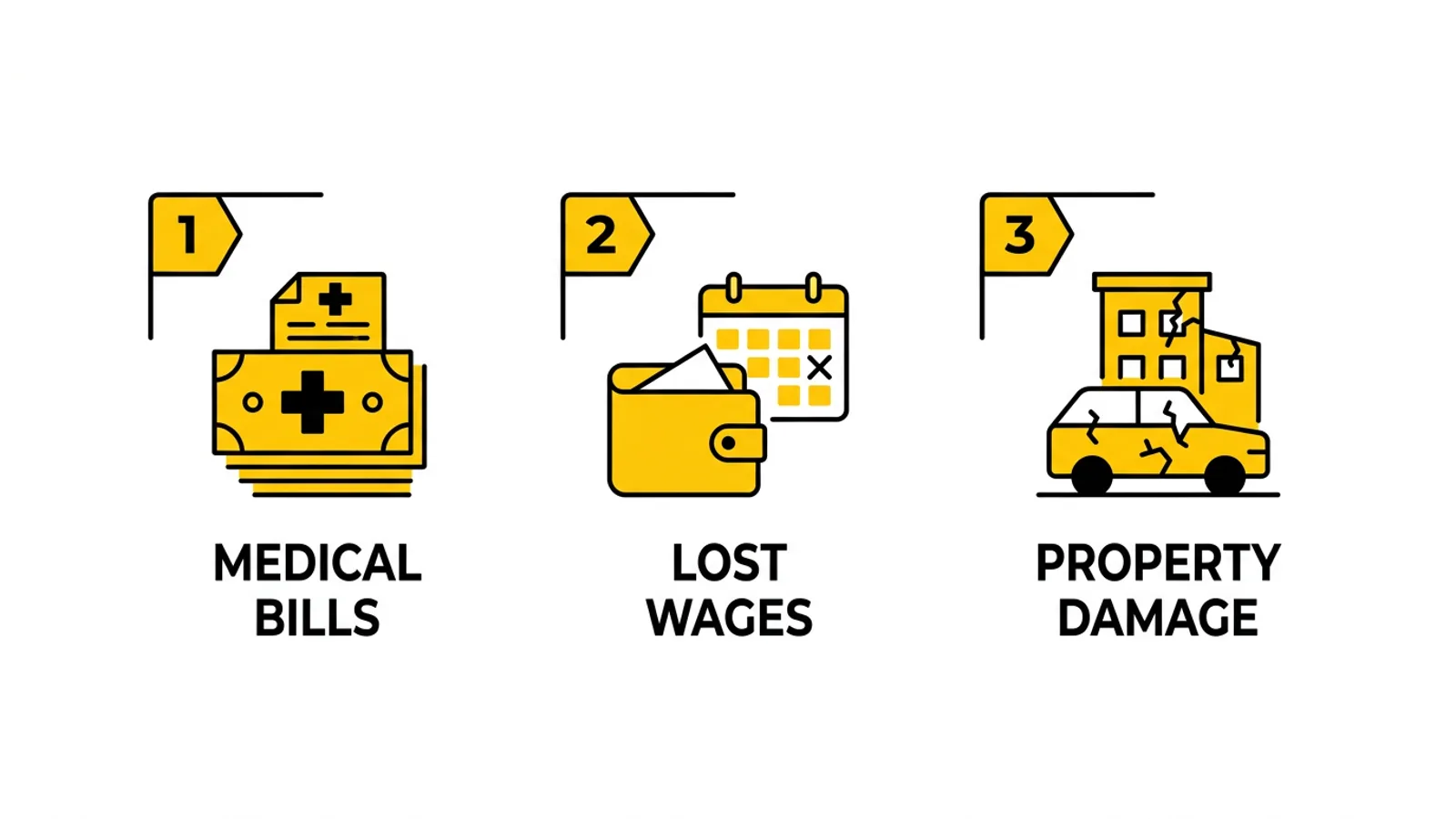
Medical bills are the category everybody names first. Lost wages belong here too, the time you missed from work while you were treating, and so does the damage to your vehicle. Then there are the smaller hard costs people forget to count. The rental car while your car sat at the shop. The prescriptions. The mileage back and forth to appointments. Every dollar the crash caused you to spend belongs in this category.
Those documented costs become the floor of the damages demand we send out on your behalf. Basically, a demand package is the file we build to prove what happened to you and what it cost: the records, the bills, the wage documentation, and the argument tying all of it back to the crash. The floor matters because the number starts at what we can prove and gets negotiated upward from there. It never starts at what feels fair.
That is why a loss you cannot show on paper functionally does not exist for settlement purposes. A $22,000 surgery is a $22,000 loss if the invoice says so. Without the invoice, you are asking an adjuster to take your word for a number, and an adjuster takes nobody's word for a number.
Timing matters as much as collection. The demand goes out once your doctors say you have reached maximum medical improvement, which everybody shortens to MMI. That is the point where you are not getting better and you are not getting worse, so you are either back at your old baseline or you have settled into a new one. Send a demand before then and you are guessing at a total while the bills are still arriving.
Property damage is economic damage too
Property damage, meaning what it costs to repair or replace your vehicle, sits in the same economic damages category as your medical bills and your lost wages. It tends to get resolved faster, and separately from the bodily-injury side of your claim. Texas's minimum insurance requirements set separate limits for bodily injury and property damage, so the two pieces of a claim can move at different speeds and settle with different adjusters. That is one more reason a complete record of every cost, and not just the medical costs, matters from the first day forward.
Property damage also gets undervalued more than people expect. The carrier's market value offer is usually lower than the real cost of replacing the vehicle, and what they owe on that piece is governed by the insurance code, not by what the car is worth to you. Fort Worth is not a city where you can skip replacing a car. If you are commuting I-820 to a job with a schedule, the gap between their number and a working vehicle is a real loss, and it is one worth documenting rather than accepting at the first offer.
Property damage moves on its own timeline
Texas's 30/60/25 minimum sets a $25,000 property damage limit separate from the bodily injury limits. So the vehicle-repair side of your claim often gets handled, and paid, well before the injury side is anywhere close to resolved. I tell clients not to read anything into how quickly, or how slowly, the property damage adjuster moves compared to the bodily injury adjuster. Different adjusters, sometimes at different companies, are often assigned to each piece of the same claim.
What matters for your economic damages figure is that once the property damage number is resolved, it folds into the same documented record as everything else: the total, provable cost this crash imposed on you. A vehicle repaired for $4,000 and a vehicle declared a total loss and paid out at its actual cash value are handled the same way procedurally. They just produce different numbers on the same line of the eventual accounting. Neither one changes how the injury side of your claim gets built or valued.
Economic damages are the hard, provable losses, okay? Anything that you can quantify tangibly with a number. You gotta think about medical bills. You gotta think about lost wages. You gotta think about the actual property damage.
The paperwork habit that protects a claim
The advice I give clients falls straight out of all this, and it is almost boring in how simple it is. Keep everything. Every bill, every receipt, every piece of paper the crash generated, whether or not you can see what it would prove.
Here is the reason it carries weight. Every document we do not have, or do not collect, or that gets left out of the file is money left on the table. Not money we argued for and lost. Money that never made it into the demand in the first place, so no one ever argued about it at all. I've seen an injured person who keeps a shoebox of receipts do more for their own claim than they realize.
That work is hardest in the exact weeks it matters most, when you are hurt, behind at work, and organizing a folder is the last thing you want to do. So keep the folder going as part of the treatment itself. Ten seconds a day while the paper is in your hand, and the record builds itself.
So pro tip: if you're in an accident, keep everything, every receipt, every bill. That way we can ensure that no money is left on the table.
Future costs are still economic damages
Economic damages are not limited to what has already been spent. An injury that needs ongoing care keeps costing money long after your case closes, and those future costs count the same way the past ones do. And so part of the work on any serious claim is predicting and projecting, through medical documentation, what you are likely to spend going forward. Your treating physicians, and in bigger cases retained experts, project the cost and the duration of the care you will need, and that projection goes into the damages figure alongside the bills already paid.
This is one of the most consequential pieces of a serious injury claim, and one of the most overlooked. Chapter 7 goes into how those projections get built, and why you only get one shot at the number. Here the claim is narrower. Future medical costs are not a separate, speculative category sitting outside your economic damages. They are the same calculation, extended forward in time, and leaving them out is a permanent loss the day you sign.
What a documentation habit looks like in practice
A workable documentation habit is simpler than it sounds. Keep one folder, physical or digital. Every medical bill, pharmacy receipt, mileage log and letter from an insurance company goes in the day it arrives. Photographs belong in the same place: the damage to both vehicles, the scene if you were able to take pictures at the time, any visible injuries as they change over the following weeks. Your phone is the most powerful documentation tool you own. Notes, photos, voice memos on how you felt that week, all of it is admissible in a way your memory nine months later is not.
When an original receipt goes missing, and a lot of times it does, the record does not have to end there. Bank and credit card statements, pharmacy printouts, and a mileage log kept on your phone can reconstruct most of what the receipt would have shown. None of those substitutes carries quite the weight of the original document. But a reconstructed record beats an unexplained hole in the accounting every time, for the same reason a documented gap in treatment does less damage than one nobody can explain.
Common Questions
- What are economic damages in a Texas car accident claim?
- Economic damages are the provable, quantifiable losses from your crash: your medical bills, your lost wages, the property damage to your vehicle, and the future medical costs your treating physician documents as likely to continue. Each one ties back to an actual number through a bill, a receipt, or a pay record. Pain and suffering sits in the other category, and it has no invoice attached to it.
- Do future medical costs count as part of a settlement, or only past bills?
- Future costs count. Your economic damages take in the costs that will keep accruing, not just what's been spent to date, projected through your medical records rather than added up from receipts already in hand. A claim that counts only what has been spent so far, and ignores treatment your doctors have documented as coming, leaves real money on the table on the day you sign.
- Why should I keep every receipt after a car accident?
- Because every bill and receipt becomes part of the documented floor the demand is built on. A loss you cannot show with paperwork is hard to put into a settlement calculation at all. So keeping your records, the medical bills, the mileage to appointments, the prescription costs, is a direct way to protect what your claim is worth. It is not a formality, and it is the one part nobody else can do for you.
- What if I don't have receipts for everything I spent because of the accident?
- Bank and credit card statements, pharmacy records, and mileage logs to and from appointments can often fill the gaps where a paper receipt went missing, though the strongest documentation is still the original bill. Start organizing this early, in the first weeks after the crash, and you will have far less to reconstruct later, when the details of a $40 pharmacy run are long gone.
- Why did my property damage claim get resolved before my injury claim?
- Property damage and bodily injury carry separate limits under Texas's minimum insurance requirements, and they are often handled by different adjusters on different timelines. So a quick property damage resolution tells you nothing about how the injury side of your claim is going. Do not read it as a signal, good or bad. The injury side moves at the speed of your medical records.
Chapter Reflection
Economic damages are the half of your claim built on paper, and paper is the one thing you have real control over in the weeks after a crash. Keep it, and the floor under your demand rises on its own. The next kind of loss arrives with no invoice at all, which is exactly what makes it harder to value and easier for an adjuster to argue down. Chapter 3 covers how pain gets priced. You can hear the full answer, in my own words, in the episode this chapter is drawn from.