
Say somebody pulled out in front of you, you had the right of way, and the crash was not a close call in your mind. Then the adjuster calls and tells you their driver says you were speeding. So now they're putting 30 percent of the fault on you. Nobody measured your speed. No reconstruction expert looked at it. It's a position, and they took it because the position is worth money to them.
Two things can shrink your settlement before anybody argues about your injuries. How much of the fault lands on you, and how much insurance the other driver was carrying. Neither one cares how good your medical proof is. A perfect file of records does not move either one. And both are worth understanding before your claim gets filed instead of after.
Modified comparative negligence
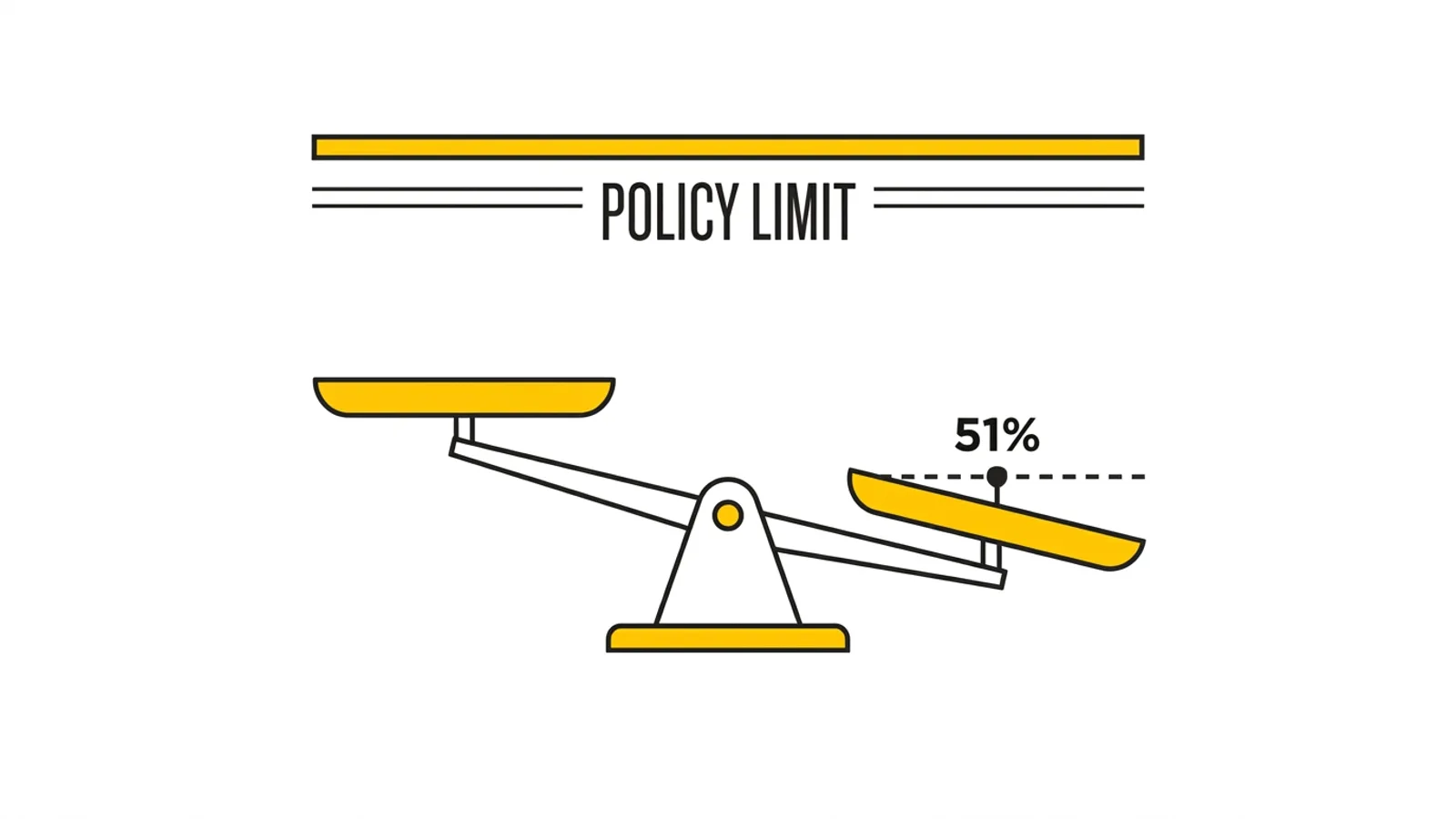
Texas follows a modified comparative-negligence rule, sometimes called the 51 percent bar rule. You can only recover damages if you're found 50 percent or less at fault for the crash. You could be 50/50 with the other driver and still recover. One more percentage point and you recover nothing at all, no matter what the total damages were worth. Below the bar, your recovery gets reduced by your own share of the fault. This rule is codified in Chapter 33 of the Texas Civil Practice and Remedies Code, the part of Texas law that splits responsibility for a crash between the people in it. The general concept is sometimes called comparative negligence.
Why insurance companies push hard on the fault percentage
So look at what that hard line does to the other side's incentives. The difference between 50 percent and 51 percent is the difference between a reduced recovery and no recovery at all. And so the at-fault driver's insurer has every reason to push your share of the blame as high as they can get it.
None of that is personal. It's the mechanical result of how the statute is written, and it's why fault percentages get argued the way they do in this state. Even when they can't push you past the bar, they'll still try to hang 30 percent on you, because 30 percent is 30 percent off the number they have to pay. On a $10,000 repair that's $3,000 out of your own pocket to make yourself whole on a wreck you didn't cause.
The only way to fight that is through documented evidence. The medical records, the imaging, the evidence about how the crash actually occurred. There isn't a second way to answer a fault argument, and an adjuster knows that better than anybody.
Texas follows modified comparative negligence. We have a 51% bar rule in Texas, and you can only make a recovery if you are 50% or less at fault. So, depending on how much you are faulted in the accident or how much a jury determines you were at fault, that would proportionately reduce your recovery.
Run the math and it gets concrete fast. Say you have $100,000 in documented damages and you're found 40 percent at fault. They take that 40 percent out and you recover the difference, $60,000. Found 51 percent at fault, you recover zero. If your case settles, that percentage gets negotiated between the parties off the evidence. If it goes to trial in Tarrant County, a jury assigns it. Either way the percentage gets built out of what was documented at the scene and in the weeks after. So the evidence you preserve early is not a separate job from the fault fight. It is the fault fight.
The ceiling insurance coverage sets
Fault is one limit. Coverage is the other, and it works differently. A policy limit caps what the insurer is contractually and legally obligated to pay, even when your damages run higher. That's a business transaction between the other driver and their insurance company, decided long before they ever hit you, and no amount of medical records raises it.
Texas requires every driver to carry a minimum liability policy, written as three numbers and commonly called 30/60/25. $30,000 in bodily injury coverage for one person. $60,000 total for the whole accident, however many people were hurt in it. $25,000 for property damage. Look at that last number for a second. It's hard to find a new car under $25,000 these days, so the property-damage minimum often falls short before anybody is even injured.
The way to close that gap is uninsured and underinsured motorist coverage, UM and UIM in Texas, and it's the single most important coverage you can carry. It's part of your own policy, and it steps into the shoes of the driver who hit you when that driver carried too little insurance or none at all. Unlike the state minimum, you pick the number. A $100,000 policy, a $300,000 policy, your call. Texas insurers have to offer it to you in writing and you have to sign a waiver to turn it down, which tells you something about how the state views it. And I'll say this plainly: don't waive it. It costs a few dollars a month.
So from day one on your case, we're evaluating collectability. Basically, that means we're not only asking what your claim is worth, we're asking what can be collected: the at-fault driver's policy, plus whatever UM or UIM is sitting behind your own. Say you were paralyzed in the wreck and the person who hit you carries a minimum policy. We need to know that in week one, not at the end, because it changes what we chase and in what order.
Why the ceiling is lower than people expect
Nine out of ten times, based on what I've seen in this state, a minimum policy is wholly insufficient. Not just insufficient for the person it hits. Insufficient to protect the person carrying it.
Go to Texas Health Harris Methodist or John Peter Smith after a serious crash and your initial trauma workup alone can run past that $30,000 per-person limit, before a single follow-up appointment happens. That's not a worst case. That's what emergency care in Fort Worth ordinarily costs. The legislature set $30,000 as a floor for everybody, not as a realistic ceiling for somebody who got badly hurt.
And so when your injury is worse than the coverage, your claim's collectable value gets capped well below what it's documented to be worth. Everything else in this book can be done right and that ceiling still holds.
Coverage the crash report doesn't show you
The at-fault driver's personal auto policy is not always the only money available, and finding the rest of it is part of the investigation we run from the first week.
Start with what the driver was doing when they hit you. If it was a commercial vehicle, and that covers a lot more than 18-wheelers, it could be your local HVAC company or somebody hauling concrete, then the driver isn't the only party who can be liable. Their employer can be. So can a manufacturer, so can the company that shipped the load. Those are businesses, which means deeper pockets and much higher limits than an individual carries. Big trucks are regulated federally, and the minimum insurance the Federal Motor Carrier Safety Administration requires them to carry is $750,000, against a Texas minimum of $30,000.
Rideshare is its own puzzle, and the coverage turns on the driver's status at the moment of impact. App off, app open and waiting, en route to a pickup, or carrying a passenger. Those are four different answers. On an active trip, a $1 million commercial policy from Uber or Lyft typically kicks in. We have a case right now where even that $1 million isn't going to be enough for what those people suffered.
There are less obvious sources too. Say a driver was intoxicated and had recently been served alcohol at a bar or restaurant before getting behind the wheel. That establishment can carry its own liability for over-serving a visibly intoxicated patron. That opens up a fully separate policy from the driver's own.
Then there's coverage you'd never look for. Policy limits are not public. Texas doesn't require an insurer to disclose what its insured is carrying before a lawsuit is filed, which is a real obstacle, and we have methods for getting at it anyway. Your own homeowner's policy can come into play in certain situations. Your UM coverage can reach you even when you were on a bike or on foot. None of this shows up on a crash report. It shows up because somebody asked the right question early enough to find it.
When accessing coverage means suing someone you know
Sometimes the only path to real coverage runs through someone you'd never think to name as a defendant. I've handled a case where a woman was seriously hurt riding in a truck her own husband was driving for work when he crashed it. Most people's instinct in that situation is that you simply can't sue your own spouse. That pursuing it would feel wrong even if you could. My answer was that we were going to. It was the only way she had any path to a real recovery.
We pursued it, and it was the only route to a recovery that reflected what she had actually lost. That result didn't happen because the facts were unusual. It happened because the coverage existed, sitting behind a policy nobody would have looked at if the family relationship had been treated as a reason not to look.
Why the size of the policy shapes the negotiation, not just the ceiling
Available coverage doesn't only cap what you can collect. It changes how the other side negotiates long before that cap is anywhere in sight.
You're going to get a very different offer on a severe injury from a carrier holding a million-dollar policy than you'll get on the same injury from a carrier holding a $30,000 minimum. The exposure on their side of the table is different, so the calculation is different. A credible trial threat pushes the value up when there's room above the offer to push into. The threat is simple enough: we're going to try this case, and you're going to have to pay more than a million dollars. Against a $30,000 policy, that same threat hits its own ceiling almost immediately.
So finding every source of coverage matters as much to the negotiation as the medical records do. The driver's policy. Any commercial policy behind it. The UM or UIM sitting on your own. Every one we find raises the ceiling we're negotiating under, and the offers move with it.
Common Questions
- What is Texas's 51 percent rule for car accident claims?
- Texas follows modified comparative negligence, and you can only make a recovery if you're 50 percent or less at fault. Below that line, whatever percentage of fault you're assigned proportionately reduces what you recover. At 51 percent or more, your recovery drops to zero, no matter how large the damages were. You could be 50/50 and still recover. One more point and you get nothing.
- How do Texas's minimum insurance limits (30/60/25) affect what I can recover?
- Texas's minimum liability policy is $30,000 in bodily injury coverage per person, $60,000 for the whole accident, and $25,000 for property damage. That caps what you can collect directly from the at-fault driver's insurance. Nine out of ten times it's wholly insufficient. A single trauma workup at a Fort Worth hospital can run past the $30,000 on its own.
- What is uninsured/underinsured motorist (UM/UIM) coverage and why does it matter?
- UM and UIM coverage sits on your own policy and steps into the shoes of the driver who hit you when that driver carried too little insurance or none at all. Texas has one of the higher rates of uninsured drivers in the country, and the state minimum is rarely enough for a serious injury. You pick the amount yourself, and it's inexpensive. Don't waive it.
- Who decides what percentage of fault I carry in a Texas car accident case?
- If your case settles, the percentage gets negotiated between the parties based on the evidence. If it goes to trial in Tarrant County District Court or the County Court at Law, the jury assigns it. Either way it's built from what was documented early: the crash report, witness statements, photos. That's why what you preserve in the first week decides an argument you'll have months later.
- Can I find out how much insurance coverage the at-fault driver has?
- Not by looking it up. Texas doesn't require an insurer to disclose its insured's policy limits before a lawsuit is filed, which makes it one of the harder pieces of the puzzle to get. We have methods and strategies for obtaining it. Meanwhile the search for other coverage runs alongside that, because you need to know how much money is available before you can make good decisions about future care.
- What if the at-fault driver was working when they hit me?
- It can change the whole coverage picture. A commercial vehicle, and that includes far more than 18-wheelers, pulls in parties beyond the driver: the employer, sometimes a manufacturer or the company that shipped the load. Those carry much higher limits than a personal policy. Rideshare works similarly, and the answer turns on the driver's status when the crash happened.
Chapter Reflection
Fault and coverage are the two things that can quietly cap your claim before anybody weighs a medical record, and only one of them is still in your hands after a crash. The other one, the coverage on your own policy, is decided on an ordinary afternoon when you renew your insurance and nobody is hurt yet. So go pull out your own auto policy tonight and find the declarations page, the summary sheet at the front that lists every coverage you carry and how much of each. Check whether uninsured and underinsured motorist coverage is on there. If there's one thing in this chapter worth doing today, that's it. Next comes the number you'll be handed at the end of all this, and why it arrives lower than it should.