
Two cars come off I-35 into the same pile-up at the same speed. One driver is sore for a week. The other ends up in an MRI tube six weeks later looking at a herniated disc. Their settlements will not resemble each other, and the reason has nothing to do with luck or with which adjuster picked up the file.
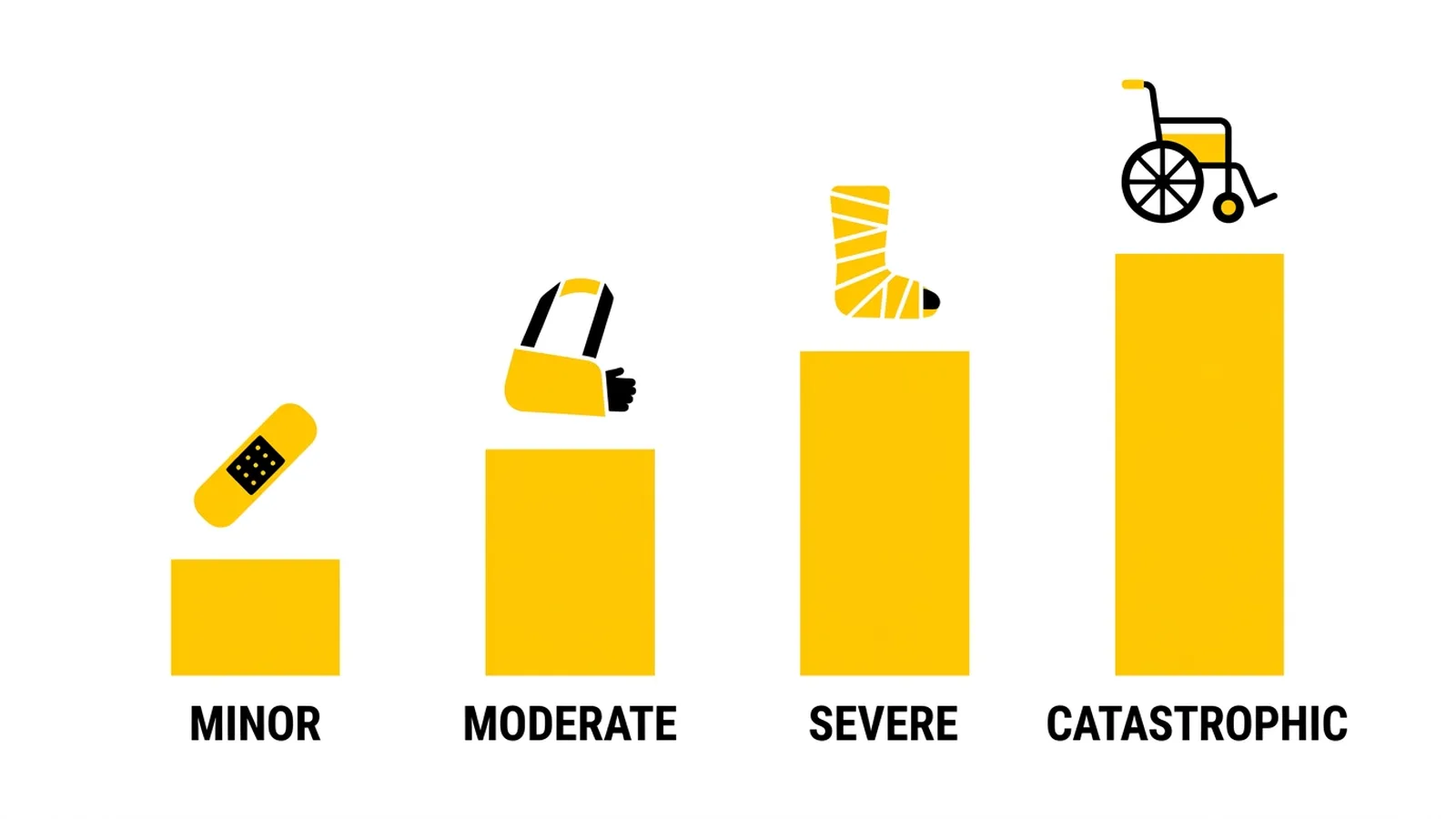
It is severity. And severity does not work like a set of boxes you get sorted into. It works like a scale that slides, and what slides it is how serious and how permanent your injury turns out to be, proven through medical records and tied specifically to damages.
The worse it is, the more it takes to compensate for it
As with anything in life, the worse it is, the more it takes to compensate for it. Somebody with a disc herniation does not have the same value on their case as somebody with a neck fracture. A strain that resolves with a few months of therapy sits at one end of the scale. A broken bone, an operation, or an injury that leaves you with a permanent impairment rating sits at the other, and the distance between those two ends is not small.
That gap is not arbitrary. A more severe injury is harder to live with, costs more to treat, and takes more proof to document. All three push in the same direction. That is why severity shows up on both sides of the ledger from the last two chapters. It raises the bills, and it raises what the pain and suffering attached to those bills is worth.
Why two similar crashes can still diverge this much
Here is the part people find hardest to believe. The crash you can see in photographs is a poor predictor of the injury you end up with. We have seen very serious injuries come out of very low impacts. I've seen two rear-end collisions at similar speeds produce a minor strain in one driver and a herniated disc in another. It comes down to how each body absorbed the force, age, prior condition, and where you happened to be sitting when it hit.
And so the injury drives value, not the speed, and sometimes not even the visible severity of the wreck. A bumper with a dent in it and a person with a diagnosed brain injury can come out of the same collision. We handled a case for a high school girl hurt in a low-speed accident who was diagnosed with a traumatic brain injury, and we recovered quite a bit of money even though the property damage and the early medical bills were both very low. Your settlement follows your actual injury. It does not follow the photographs.
There's a sliding scale on value, and depending on how serious and how permanent the injuries are, which need to be proven through medical records and then tied specifically to damages, is how we base that... Soft tissue injuries like neck strains settle far below what a fracture, a surgery, or a permanent impairment rating would call for in a settlement.
Imaging and specialist notes carry the weight
Severity gets proven through imaging and through specialist notes. X-rays, MRIs, CT scans, and in brain injury cases more advanced scans that a basic CT would miss. Then the opinions of the physicians who actually treated you.
That distinction matters in the negotiation. A treating specialist's documented opinion carries weight with an adjuster, and with a jury later, that your own description of how bad it feels never will. Not because anybody assumes you are exaggerating, but because a specialist's finding does not depend on anyone's account of how something feels. Basically, imaging and specialist notes make the severity credible, and credible severity is what gives us leverage.
So the strength of the proof, not the size of the opening demand letter, is what moves a number.
The severe injury that's easy to miss at first
Not every severe injury announces itself in the first 48 hours. Traumatic brain injuries are the clearest example, and they sit at the far end of this scale precisely because they get missed at the exact moment missing them costs the most.
A concussion, or a mild TBI, can look like a headache and some fog for the first few days. Symptoms do not always show up right away. Sometimes you are not knocked out at all. The memory gaps, the mood swings and the trouble sleeping surface hours or days later, once the adrenaline is gone and you are trying to go back to work. Mild does not mean minor. A mild traumatic brain injury can cause problems that last a lifetime, and it is called mild because of how it graded on a scale in an emergency room, not because of what it will cost you.
That's why I built our intake process around specifically asking about symptoms that point toward a traumatic brain injury: headaches, memory gaps, sensitivity to light, trouble concentrating. We don't wait for you to volunteer them. Not every law firm asks these questions at intake. These are invisible injuries. A laceration or a scar is visible; a brain injury is not, and its symptoms get confused with other things, including ordinary stress from having just been in a wreck.
It hurts most the people who assume a headache is just a headache. They settle early. Then they find out later what the crash actually did to them, and there is no reopening a settled case to add a diagnosis that showed up afterward. That is the permanence problem Chapter 7 covers. Caught in week one, while there is still time to document it and still time to treat it, the same injury sits in a completely different place on the scale.
Why severity has to be caught early, not just proven eventually
I tell other attorneys this directly when they ask: a case is made or broken in the first week. That is not a line about pressure. It is a description of how severity gets locked in.
What your intake asks about. Which specialists you see in the first days. What symptoms a treating physician is prompted to check for. All of it shapes what your record eventually says about how bad this was. A sliding scale only helps you if the injury sitting on it was identified in the first place, and an injury nobody asked about in week one often never gets identified at all.
So severity is not something you wait around to discover as treatment unfolds. It gets investigated: what hurts, what does not feel right yet, what has not shown up but might. If you are telling yourself your injury is minor because it feels minor right now, you are exactly the person a thorough intake exists to protect. Feeling minor and being minor are not the same thing, and the distance between them is where settlement value quietly disappears. It's also why I'd rather spend the money early on a specialist referral that turns out unnecessary than skip it and find out months later that something more serious was there the whole time.
Permanency changes the calculation
A soft-tissue injury that clears up in a few months gets valued differently than one that leaves something behind for good. A lot of times people cannot return to their previous baseline, meaning the way they moved and functioned before the wreck. That is a lasting and permanent impairment, and a medical doctor can issue an impairment rating for it.
And so permanency moves both sides of the ledger at once. Your economic damages go up, through ongoing care and future treatment. Your non-economic damages go up too, because the loss of enjoyment of life is no longer measured in months. Chapter 7 covers how future medical costs get built into a settlement once permanency is established, and why that projection has to be right the first time.
Common Questions
- How does injury severity change what a Fort Worth car accident claim is worth?
- Severity works on a sliding scale. The more serious and more permanent your injury, and the better it is documented through imaging and specialist notes, the higher the value of your claim. A minor soft-tissue injury settles well below what a fracture, a required surgery, or a permanent impairment rating calls for, because the treatment, the proof, and the life impact behind those are genuinely different.
- What is a back or neck injury settlement worth after a Texas crash?
- I never give you a specific number up front, and no good attorney will. Too much turns on your diagnosis, the treatment you need, whether surgery gets recommended, and whether you end up with a permanent impairment rating. Back and neck injuries do tend to drive higher damages on both sides, because they affect your whole body, how you move and how you function. Your value follows your documentation.
- How do doctors document that an injury is permanent?
- A treating physician issues an impairment rating once your injury has reached a stable, final state and you have not gotten back to your prior baseline. That rating, sitting alongside the imaging and specialist notes that established where you started, is the record your claim relies on to prove permanency rather than assert it. It is a medical judgment, made by your doctor, not a position taken by your lawyer.
- Can a mild-looking injury still be worth a significant settlement?
- Yes, if the records establish it as severe or lasting. We recovered quite a bit for a high school girl hurt in a low-speed crash with a diagnosed brain injury, even though her property damage and early bills were low. How the crash looked in photographs matters far less than what your imaging, your specialists, and your treatment history end up establishing about the injury itself.
- Can a car accident cause a traumatic brain injury even without a direct hit to the head?
- Yes. A TBI comes from rapid acceleration or the brain striking the inside of the skull, so a whiplash-type wreck can cause one with no skull fracture and no blow to the head at all. Early symptoms, headache, confusion, sensitivity to light, are easy to read as ordinary post-crash grogginess. Somebody has to ask about them instead of waiting for you to bring them up.
- What if my doctor said I was fine right after the accident, but I started feeling worse weeks later?
- That is common with injuries that take time to present, and back, neck and brain injuries take months and months to reveal themselves. It does not mean your injury is not real, and it does not mean it is disconnected from the crash. Get back in with a doctor as soon as symptoms appear or worsen, and make sure the visit is documented as connected to the original wreck.
Chapter Reflection
Severity sets the ceiling on what your claim can be worth, and the medical record is the only thing that gets you there. Which puts a lot of weight on one week of your life, the week right after a crash, when you are least equipped to think about any of it. The next two chapters are about that record: first how it proves the crash caused your injury at all, and then what happens when you were already carrying something before the wreck ever happened.